Alternative
09:5910:50
52 min · 1 change · Free in 2nd class
HamiliusRumelange, Laangegronn
Walk about 1 min to Hamilius-Centre (Tram)
Change · 23 h 59 min wait
09:59
T1towards Gasperich, Stadion
6 min ride
10:05
Walk about 4 min to Luxembourg, Gare Rocade
5 min
On track · 5 min to change
4 min walk to Luxembourg, Gare Rocade for the 508.
Change · 1 min wait
10:10
508towards Ottange, Pl. de Montcontour
25 min ride
10:35
Walk about 15 min to Rumelange, Laangegronn
Near Rumelange

The Auto-Pédestre starts at the station in Rumelange, where you can decide whether to head straight towards nature or spend a little more time in the town of Rumelange. If you initially choose the green option, you…

Read more

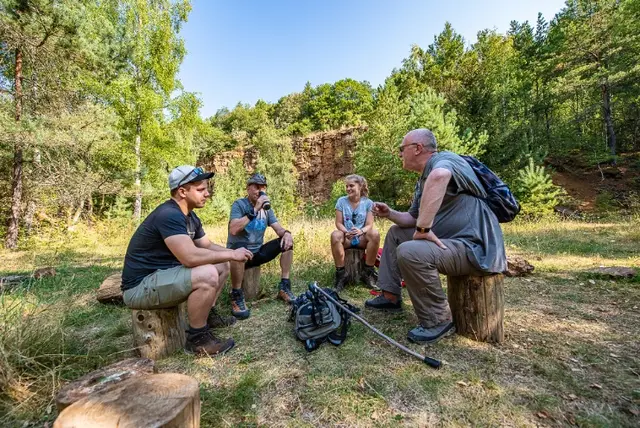
The Auto-Pédestre starts at the station in Rumelange, where you can decide whether to head straight towards nature or spend a little more time in the town of Rumelange. If you initially choose the green option, you enter the Haard-Hesselsbierg-Staebierg nature reserve, the largest in Luxembourg. Here you will witness former mining waste heaps and see the red of the iron ore. The path mainly runs through the forest, but you will also be back in the hustle and bustle of the town in no time.

  • L-3739 Rumelange
  • Run by Auto-Pédestre Wanderweg Rumelange II

The "Resistenz Wee" in Rumelange sheds new light on the Nazi occupation between 1940 and 1944; during this time, Rumelange was one of the key locations for the Luxembourgish resistance. This themed trail, developed in…

Read more

The "Resistenz Wee" in Rumelange sheds new light on the Nazi occupation between 1940 and 1944; during this time, Rumelange was one of the key locations for the Luxembourgish resistance. This themed trail, developed in collaboration with the National Museum of the Resistance and Human Rights in Esch-sur-Alzette, tells local stories, events, and fates—the stories of people. Along the trail are 12 stations. They recount stories of support networks, resettlements, personal resistance, but also of collaboration, propaganda and counter-propaganda, and the direct and indirect damage and wounds that Rumelange suffered during the war years. The trail stops at various stations where plaques and monuments commemorate the events of the occupation. All locations have an audio guide that will tell you more about the history.

  • *****

The iron mines have played an active role in Luxembourg’s history and economy. From the 1870s to the 1990s, Luxembourg's iron mines had a major impact on the lives of the country’s inhabitants.

Read more

The iron mines have played an active role in Luxembourg’s history and economy. From the 1870s to the 1990s, Luxembourg's iron mines had a major impact on the lives of the country’s inhabitants. Nowadays, we have forgotten what the daily life of the miners was like, the difficulty of their work, the kinds of tools they used. At the National Mining Museum, you’ll learn all about how mining worked and discover more than a century of technological development through its a large collection, most of which is displayed in underground galleries. The tours of the mine are always for groups, escorted by a museum guide. More information about accessibility can be downloaded as a.pdf file

  • Carreau de la mine Walert L-3714 Rumelange
  • Website
Data: Administration des transports publics and Luxembourg for Tourism, CC BY 4.0