Public transport

Getting to Dudelange (Usines) by public transport

Dudelange (Usines) has 1 stop, served by 2 train lines. Trains stop at Dudelange (Usines), Gare.

Direct lines run to Volmerange-les-Mines, Bettembourg, and Luxembourg.

Buses, the tram and trains are free within Luxembourg; only 1st class on trains needs a ticket.

Within a short walk of its stops: Documentation Centre for Human Migrations, Waassertuerm + Pomhouse, and Minett Trail: Rumelange Gare - Dudelange Gare.

Plan a journey to Dudelange (Usines)
Places to see in Dudelange (Usines)

The Documentation Center for Human Migrations (CDMH) does researches and organises exhibitions on history of migrations, mainly in the context of Luxembourg and its neighbouring regions.

Read more

The Documentation Center for Human Migrations (CDMH) does researches and organises exhibitions on history of migrations, mainly in the context of Luxembourg and its neighbouring regions. The museum gives an impression of the evacuation of the men of Dudelange, the German occupation, the forced enlistment, the militia and the liberation. Venture into the heart of human migration Immigrants now make up a significant part of the Grand Duchy’s population, and without them, Luxembourg wouldn’t be the country it is today. By understanding this phenomenon, the context and the times in which migration occurs, the people who immigrate and also those who emigrate, and when, how and why they choose to do so, we can gain a deeper understanding of who we are. Luxembourg is now intrinsically linked to migration, which is what makes its culture so rich and diverse. Through temporary exhibitions highlighting the human and social aspects of migration, the Centre de Documentation sur les Migrations Humaines (CDMH) offers visitors the opportunity to discover a history that is very much our own. And not only that! The exhibitions include stories from neighbouring countries as well. The CDMH also offers guided tours of the Italian Quarter in Dudelange. Definitely worth checking out!

  • Rue Gare-Usines L-3481 Dudelange
  • Website

Consisting of a restored water tower and a pumping station, the Waassertuerm+Pomhouse site forms a remarkable architectural ensemble that is part of the wealth of Luxembourg's industrial heritage. The former industrial…

Read more

Consisting of a restored water tower and a pumping station, the Waassertuerm+Pomhouse site forms a remarkable architectural ensemble that is part of the wealth of Luxembourg's industrial heritage. The former industrial wasteland has been converted into an exhibition and event venue and is now dedicated to the audiovisual arts. The water tower contains two galleries inside the base and the tank which house temporary exhibitions. The visitor is constantly confronted with the proportions of a tower seen from the outside and therefore accessible from the inside. By accessing the tower tank, the visitor can enjoy an impressive panoramic view of the abandoned site of the rolling mill, the town of Dudelange and the surrounding landscape. During this ascent, the visitor can take a step back from the first part of the exhibition, before plunging back into the subject in the tank. Finally, the no less impressive descent leads via the hexagonal external staircase to the panoramic terrace and the site's "wooded garden". Just next door, at the foot of the tower, is the former pumping station, which has been transformed into an event venue and a platform for meetings and exchanges. Composed of a restored water tower and a pumping station, the Waassertuerm + Pomhouse site forms a remarkable architectural ensemble which is part of the wealth of Luxembourg's industrial heritage. The former industrial wasteland has since been converted into an exhibition and event venue and is now dedicated to the audiovisual arts. For more information concerning the temporary exhibits and the programmation of audiovisual arts, please visit: www.cna.lu

  • 1b rue du Centenaire L-3475 Dudelange
  • Run by Centre national de l'audiovisuel
  • Website

The Minett Trail is a 90-kilometer-long hiking trail that runs across the Minett region. In ten stages, you can experience smaller and larger towns as well as eight nature reserves. These impress with old forests and…

Read more

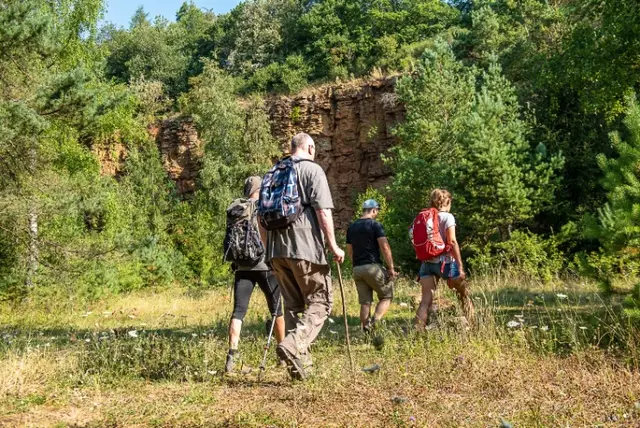
The Minett Trail is a 90-kilometer-long hiking trail that runs across the Minett region. In ten stages, you can experience smaller and larger towns as well as eight nature reserves. These impress with old forests and former open-pit mining areas. They are unique in Luxembourg due to the steep rock faces, the red earth, and mine entrances. On this section, you will hike through the huge "Haard - Hesselsbierg - Staebierg" nature protection zone; massive rock formations, red cliffs, and dense forests dominate this former lunar landscape. For decades, the precious "Minette" ore was mined here, which from the early 20th century until late in the 1980s made an essential contribution to the country's economic development. Within the nature reserve, the path passes by the longest continuous rock face in Europe, which also stands out due to its distinctive red color. Together with the exceptional biodiversity and nature in the "Haard-Hesselsbierg-Staebierg" reserve, this characterizes the strengths of this section. At the start in Rumelange, you will also find the Musée National des Mines, where you can participate in guided tours through the tunnels. Along the way, there are further witnesses to the industrial past: a slag tipping wagon (the "Humpen") and views of the former industrial area in Dudelange when arriving down from the nature reserve - with a view of the old water tower - stand out clearly. WARNING: Unfortunately, this stage of the Minett Trail is regularly subject to vandalism. We recommend downloading the GPX data before hiking as the markings are often damaged or removed.

  • L-3409 Dudelange

Along the path, 17 display panels explain the former open-pit mining area as well as the current nature reserve. Discover the extensive high plains of the former open-pit mine, walk along a path winding through forest…

Read more

Along the path, 17 display panels explain the former open-pit mining area as well as the current nature reserve. Discover the extensive high plains of the former open-pit mine, walk along a path winding through forest between slipped ground, admire tall rock walls, and surely see red soil!

  • rue Jean-Pierre Bausch L-4114 Esch-sur-Alzette
  • Run by ANF

The mountain bike trail "Haard-red" takes you through former open-pit mining areas, which were officially declared a national nature reserve in 1994. Iron ore was once mined here, but after the cessation of mining, the…

Read more

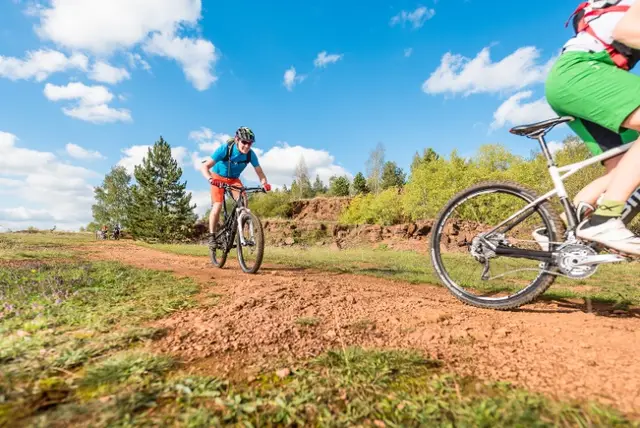
The mountain bike trail "Haard-red" takes you through former open-pit mining areas, which were officially declared a national nature reserve in 1994. Iron ore was once mined here, but after the cessation of mining, the area was simply left to the natural process of vegetation development. Leave the city and ride into the countryside in just 5 minutes! This track is just right for you if you want to gain experience riding singletrails. The route is not technically very demanding and is very varied. Along the way, numerous viewpoints offer the opportunity to take spectacular photos.

The sculpture shows Italian immigrants, carrying their suitcases and crossing the "Porte d'Italie", the bridge symbolically separating the "Italian" district from the center of the city. On the other side of the gate…

Read more

The sculpture shows Italian immigrants, carrying their suitcases and crossing the "Porte d'Italie", the bridge symbolically separating the "Italian" district from the center of the city. On the other side of the gate they are welcomed by a family. On the base the Italian and Luxembourgian text of Matthew 25:35: Ero straniero, e mi avete accolto - "I was a stranger and you welcomed me."

  • Gare-Usines L-3481 Dudelange
  • Run by Centre de Documentation sur les Migrations Humaines
  • Website
Data: Administration des transports publics and Luxembourg for Tourism, CC BY 4.0