Public transport

Getting to Gare by public transport

Gare has 1 stop, served by 14 bus lines.

Direct lines run to Luxembourg, Hollerich, Limpertsberg, Cents, Cessange, Strassen, Dommeldange, and Hamilius (Bus).

Buses, the tram and trains are free within Luxembourg; only 1st class on trains needs a ticket.

Within a short walk of its stops: National Museum of Natural History - Natur Musée, Central Railway Station, and Petrusse Casemates.

Plan a journey to Gare
Places to see in Gare

Natural history and the natural sciences are presented here in a simple yet fascinating way: in addition to its permanent exhibition, the “natur musée” regularly hosts special and focused exhibitions all about plants,…

Read more

Natural history and the natural sciences are presented here in a simple yet fascinating way: in addition to its permanent exhibition, the “natur musée” regularly hosts special and focused exhibitions all about plants, animals and the universe. It’s educational, lively and unusual. The museum’s two gardens, shop and cafeteria are also pleasant places to spend time. The museum is located in the charming Grund district and can be easily reached via the lift from the Plateau St. Esprit or on foot along the picturesque cobbled streets surrounding the Corniche.

  • 25 Rue Münster L-2160 Luxembourg City
  • Run by 'natur musée'
  • Website

In 1859 the first railway station of the city started to operate; for military reasons timber was the basic construction material.

Read more

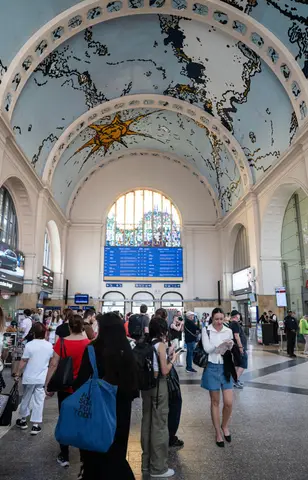
In 1859 the first railway station of the city started to operate; for military reasons timber was the basic construction material. Between 1907 and 1913 the German architects Rüdell, Jüsgen and Scheuffel planned and organized the gradual replacing of the half-timbering by modern building techniques. The monumental main building and the high clock tower are in “Moselle Baroque”. In the entrance hall a mosaic window discloses the outline of the city; the ceiling was repainted by the Luxembourg artist Armand Strainchamps.

  • Place de la Gare L-1616 Luxembourg

Their origin goes back to 1644, when the Spaniards reinforced the medieval fortifications. Under the supervision of the Swiss fortress builder Isaac von Treybach, they built - among other defence works-the powerful Beck…

Read more

Their origin goes back to 1644, when the Spaniards reinforced the medieval fortifications. Under the supervision of the Swiss fortress builder Isaac von Treybach, they built - among other defence works-the powerful Beck Bastion, named after Governor Baron Johann von Beck, a native of the city who had played a key role in the Wallenstein affair on the side of the Emperor. Initially this bastion was as high as the adjacent terraces on the right; it was raised to the present level of Constitution Square (the wall is 27 meters high) by Vauban in 1685. In 1673 the Spaniards erected the so-called "Ravelin du Pate" to strengthen the defence of the Beck Bastion; this triangular construction is one of the few well-kept fortifications. Marshall de Vauban conferred the present shape to all the Petrusse fortifications and built the "Small Staircase". From 1728-29 the Austrians added the "Bourbon Lock" and the "Large Staircase" and in 1746 the casemates of the "Petrusse Battery" (54 gun emplacements). One century passed and the fortress was enlarged and reinforced: the second ring was extended and the third started, so that Luxembourg became the "Gibraltar of the North". By and by, the Petrusse fortifications fell into oblivion and neglect, as their strategic momentum limited itself to the valley. After the dismantling, stipulated by the 1867 London Treaty, they confined themselves to walling up the loopholes and most entrances. Only in 1933 were the Petrusse casemates valorized again: on 26th July, the first visitors were able to visit them.

  • Place de la Constitution L-2449 Luxembourg City
  • Run by Luxembourg City Tourist Office
  • Website

Situated near the Cathedral and the Government district, Place de Clairefontaine was redesigned at the end of the eighties in the framework of extensive restoration and reconstruction involving the entire district.

Read more

Situated near the Cathedral and the Government district, Place de Clairefontaine was redesigned at the end of the eighties in the framework of extensive restoration and reconstruction involving the entire district. The name of the square comes from a place of shelter, a refuge belonging to the abbey of Clairefontaine which is near the Belgian border. The same refuge was demolished in 1933. A monument in honour of Grand Duchess Charlotte (1896-1985), designed by the Parisian sculptor Jean Cardot, was erected on this square in April,1990. Grand Duchess Charlotte Among the famous statues in Luxembourg, the statue of Grand Duchess Charlotte on Place de Clairefontaine was designed by the french sculptor Jean Cardot. On 29th April 1990, the 2.75-metre-high bronze statue was officially inaugurated in the presence of the Grand Ducal family. Grand Duchess Charlotte (1896-1985), who was very popular with the Luxembourgers, ruled from 1919 to 1964.

  • Place Clairefontaine L-1536 Luxembourg
  • Run by Place Clairefontaine

This museum brings the capital’s more than one thousand years of history to life: “The Luxembourg Story” is a permanent exhibition that shows the development of the city through countless original artefacts and models,…

Read more

This museum brings the capital’s more than one thousand years of history to life: “The Luxembourg Story” is a permanent exhibition that shows the development of the city through countless original artefacts and models, some of them incorporating multimedia animations. The new UNESCO Visitor Centre fits in perfectly here and continues the same historic theme, while two further floors of the museum house temporary exhibitions. The Lëtzebuerg City Museum is housed in four historic buildings which were built between the 17th and 19th centuries, in some cases on medieval foundations. A special highlight is the vast glass lift that can carry up to 65 people at a time along the ancient walls inside the museum.

  • 14 Rue du Saint-Esprit L-1475 Luxembourg City
  • Website

A wall like a blank page is the concept behind the project "LE MUR Luxembourg". Inspired by the "MUR Oberkampf" in Paris, where over 300 artists have left their mark over the years, and following on from the graffiti…

Read more

A wall like a blank page is the concept behind the project "LE MUR Luxembourg". Inspired by the "MUR Oberkampf" in Paris, where over 300 artists have left their mark over the years, and following on from the graffiti project at the ventilation tower at Place Guillaume II, "LE MUR LUXEMBOURG" will feature graffiti and street art in a range of styles on its 30 m2 urban canvas.

  • rue du St-Esprit L-1475 Luxembourg
Data: Administration des transports publics and Luxembourg for Tourism, CC BY 4.0