Public transport

Getting to Wiltz by public transport

Wiltz has 23 stops, served by 2 train lines and 46 bus lines. Trains stop at Wiltz, Gare.

Direct lines run to Kautenbach, Bastogne, Clervaux, Redange/Attert, Goebelsmühle, Hosingen, Oberwampach, and Goesdorf.

Buses, the tram and trains are free within Luxembourg; only 1st class on trains needs a ticket.

Within a short walk of its stops: Fire brigade museum an der Géitz, The PLOMM children’s museum, and Wiltz Castle.

Plan a journey to Wiltz
Places to see in Wiltz

In the fire brigade museum in Wiltz you can not only admire old fire engines but also learn a lot about the equipment and the daily work of the fire brigade.

Read more

In the fire brigade museum in Wiltz you can not only admire old fire engines but also learn a lot about the equipment and the daily work of the fire brigade. At the beginning of 2018, 4 fire brigade veterans started work on a small fire brigade museum on their own initiative. Here you will find many objects that play a major role in the daily work of the fire brigade. Let yourself be surprised how the fire brigade used to work.

  • 2 Rue Geetz L-9558 Wiltz
  • Run by Pompjeesmusée an der Géitz
  • Website

Everything in the museum is designed for participation: whether in our permanent exhibition, The Tree of Tales, our temporary exhibition LOVE or in our creative workshops – there are exciting things to discover and try…

Read more

Everything in the museum is designed for participation: whether in our permanent exhibition, The Tree of Tales, our temporary exhibition LOVE or in our creative workshops – there are exciting things to discover and try out everywhere! Come over!

  • Avenue de la Gare L-9537 Wiltz
  • Run by Kannermusée Plomm
  • Website

The actual, first castle of Wiltz was located in Niederwiltz, where the deanery church stands today. It was supposed to protect the town from its enemies, but the location was so badly chosen that it was constantly…

Read more

The actual, first castle of Wiltz was located in Niederwiltz, where the deanery church stands today. It was supposed to protect the town from its enemies, but the location was so badly chosen that it was constantly taken. In the 13th century, searching for a more favourable location, the lords of Wiltz built the new castle on a higher promontory. In 1631, under the rule of Count Jan, construction began on the Renaissance castle that still stands today. The new building was completed around 1720. Today, the castle houses the National Brewing Art Museum and the Museum of the Battle of the Bulge, as well as a tourist information. In June and July, the staircase of the castle serves every year as the stage for the Wiltz Festival. Concerts, theatre events and other artistic performances are presented live on stage in the magnificent amphitheatre in front of the backdrop of the castle.

  • 35 Rue du Château L-9516 Wiltz
  • Run by Syndicat d'Initiative et du Tourisme Wiltz
  • Website

The Schumannseck was the site of the deadliest fighting of the Battle of the Ardennes. For several weeks, American soldiers and the German army faced each other in a deadly war of attrition. Thousands of lives were…

Read more

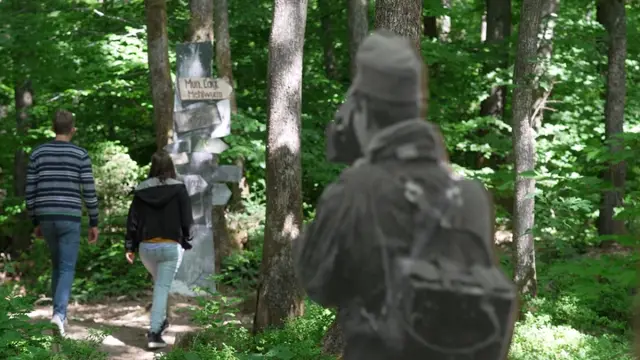
The Schumannseck was the site of the deadliest fighting of the Battle of the Ardennes. For several weeks, American soldiers and the German army faced each other in a deadly war of attrition. Thousands of lives were sacrificed. This place preserves the traces of the fighting that took place there from December 27, 1944, to January 21, 1945. The experience route leads through the still visible remains such as foxholes, trenches, and bomb craters. Along the innovative memorial path, there are 65 life-size silhouettes created based on original photographs from the time of the battle. These images were mostly taken at Schumannseck or in the nearby area. Some of these figures have been supplemented with color images of items from national collections. Reconstructions of military shelters, some located in old quartzite quarries, give an idea of the conditions under which soldiers and civilians tried to survive the merciless close-combat battles in the freezing winter. Using QR codes on the trilingual information panels (FR, EN, DE), visitors can access over 150 authentic and moving eyewitness accounts at 20 thematic stations, as well as new historical insights made available through audio and video recordings. The route covers 1.2 km (small loop) or 2.8 km (full circuit). Guided tours are available upon request.

  • Schmuann'seck L-9401 Vianden
  • Run by Tourist Info Wiltz
  • Website

After the introduction of compulsory military service in August 1942, a general strike broke out in Wiltz against the occupiers. The strike movement quickly spread throughout the country, which the occupiers responded…

Read more

After the introduction of compulsory military service in August 1942, a general strike broke out in Wiltz against the occupiers. The strike movement quickly spread throughout the country, which the occupiers responded to with brutal violence. 21 Luxembourgers were executed. A monument in the shape of a lighthouse commemorates the victims of the general strike during the Second World War. It was built of Wiltz slate and inaugurated on 30 September 1956. On the street side, a relief made of red sandstone depicts the battle of the biblical David against Goliath and symbolises the courageous resistance of the Luxembourgers against the overpowering Third Reich. The reverse side shows Luxembourg strikers arrested and collapsing under bullets in the Hintzert concentration camp. The monument stands as a memorial to the free world to stand up every day against violence, oppression and disregard for human rights. Every year on 31 August, the courageous victims are commemorated in a memorial ceremony.

  • 35 Rue du Château L-9516 Wiltz
  • Run by Syndicat d'Initiative et du Tourisme Wiltz
  • Website

During the Battle of the Bulge, the "Schumann's Eck" was a strategically important road junction, which unfortunately became one of the cruellest battlefields in Luxembourg.

Read more

During the Battle of the Bulge, the "Schumann's Eck" was a strategically important road junction, which unfortunately became one of the cruellest battlefields in Luxembourg. The "National Liberation Memorial" commemorates the thousands of soldiers that died in this battle. Another memorial called Massegraf (mass grave) is located on the spot where more than 160 German and some American soldiers were temporarily buried. A memorial trail of 3 kilometres leads through the forest past old, partly reconstructed trenches. Life-size historical photos of American and German soldiers as well as Luxembourg civilians at various stations illustrate the events of that time.

  • 35 Rue du Château L-9516 Wiltz
  • Run by Syndicat d'Initiative et du Tourisme Wiltz
  • Website
Data: Administration des transports publics and Luxembourg for Tourism, CC BY 4.0