Timing · Late evening: the last departure from here tonight is line 622 to Luxembourg, Gare Centrale routière at 00:45.
- 4Dommeldange, Parc de l'Europe23:51·Scheduled6 min
- 612Schifflange, Stadhaus23:51·Scheduled7 min
- 22Luxembourg, Gare Centrale routière23:56·Scheduled11 min
- 622Bascharage/Sanem, Gare routière00:03·Scheduled19 min
- 22Hollerich, P+R Bouillon00:06·Scheduled21 min
- 4Leudelange, Gemeng00:12·Scheduled27 min
- 611Luxembourg, Gare Centrale routière00:16·Scheduled31 min
- 622Luxembourg, Gare Centrale routière00:45·Scheduled00:45
Live times from mobiliteit.lu, refreshed every 30 seconds.
Lines from here
- 4Leudelange, Gemeng · Dommeldange, Parc de l'Europe
- 10Steinsel, Bourgaass · Bertrange, Belle-Etoile · Hollerich, P+R Bouillon
- 14Cessange, Boy Konen · Cents, Waassertuerm
- 20Kockelscheuer, Parc Luxite · Merl, Marcel Cahen · Gasperich, Stade de Luxembourg
- 22Hollerich, P+R Bouillon · Luxembourg, Gare Centrale routière · Strassen, Primeurs
- 27Hamm, Rue de Bitbourg · Kockelscheuer, Patinoire
- 74Bonnevoie, Huese Vic · Merl, Geesseknäppchen (S)
- 94Limpertsberg, Theater (Bus) · Limpertsberg, L.T.C.
- 602Luxembourg, Gare Centrale routière · Val de Briey, Albert 1er
- 603Luxembourg, Gare Centrale routière · Piennes, Zone d'activités
- 611Noertzange, Gare routière · Luxembourg, Gare Centrale routière
- 612Luxembourg, Gare Centrale routière · Schifflange, Stadhaus
- 622Bascharage/Sanem, Gare routière · Luxembourg, Gare Centrale routière
- 623Luxembourg, Gare Centrale routière · Bascharage/Sanem, Gare routière
- 691Steinsel, Zone Industrielle · Niederkorn, Maartplaz Niederkuer
- CE2Livange, Am Duerf · Cessange, EIGT
- CN1Hollerich, P+R Bouillon · Cents, Waassertuerm · Neudorf, Fixmer
- D37Luxembourg, Gare Centrale routière · Merl, Geesseknäppchen (S)
- E42Limpertsberg, L.T.C.
- R02Gasperich, Gaasperecher Bierg · Mondorf-les-Bains, Ecole Internationale
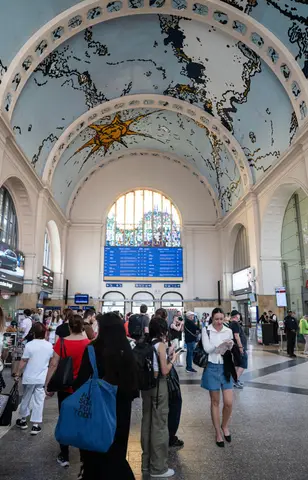
In 1859 the first railway station of the city started to operate; for military reasons timber was the basic construction material.
Read more
In 1859 the first railway station of the city started to operate; for military reasons timber was the basic construction material. Between 1907 and 1913 the German architects Rüdell, Jüsgen and Scheuffel planned and organized the gradual replacing of the half-timbering by modern building techniques. The monumental main building and the high clock tower are in “Moselle Baroque”. In the entrance hall a mosaic window discloses the outline of the city; the ceiling was repainted by the Luxembourg artist Armand Strainchamps.
- Place de la Gare L-1616 Luxembourg
The tour starts at the central train station from where Jews were deported. The path then leads to the Arbed building, then the seat of the Gauleiter, who issued anti-Jewish laws and regulations.
Read more
The tour starts at the central train station from where Jews were deported. The path then leads to the Arbed building, then the seat of the Gauleiter, who issued anti-Jewish laws and regulations. It continues to the site of the former Jewish school (72 bd de la Pétrusse), from where the children were expelled, and then to Villa Pauly, Gestapo headquarters, from where the deportations were organised. The memorial route continues to the site of the second state synagogue (rue Notre-Dame), which was closed in May 1941, desecrated by the Nazis in 1943 and demolished. Continuing along the route, one pauses at 13 rue du Marché aux Herbes, home of the shop of Albert Nussbaum, a clothing manufacturer who organised the emigration of Jews, saving some 1,000 people from the Holocaust. The route also touches on the site of the first synagogue, which stood at number 6 rue de la Congrégation until 1891. It ends at the Kaddish Monument (Boulevard Roosevelt), which commemorates the persecution, deportation and murder of more than 1,300 local Jews and those who fled to Luxembourg during the National Socialist dictatorship. Free audio guide available.
- L-1111 Luxembourg
- Run by Shoah-Gedenkweg in Luxemburg Stadt
This route is intended for endurance hikers. It cannot be shortened except for an early shortcut at the outskirts of Luxembourg City towards the Sandweiler-Contern station and the branch (CFL 20a) to Noertzange station,…
Read more
This route is intended for endurance hikers. It cannot be shortened except for an early shortcut at the outskirts of Luxembourg City towards the Sandweiler-Contern station and the branch (CFL 20a) to Noertzange station, which reduces the total distance by only 1.2 km. It is a beautiful day route, among others through the Kockelscheier recreation area, from the capital to the gates of the Minette region in the south of the country. The trail mostly follows the national hiking path Sentier de l'Alzette, and nature lovers enjoy the varied landscape and the meanders of the stream connecting the largest cities of the Grand Duchy. Don’t forget enough provisions and drinks! © CFL
- 11 Pl. de la Gare L-1616 Luxembourg
- Run by Visit Minett
- Website