Public transport

Getting to Hollerich by public transport

Hollerich has 15 stops, served by 2 train lines and 44 bus lines. Trains stop at Hollerich, Gare.

Direct lines run to Luxembourg, Merl, Kockelscheuer, Howald, Cessange, Limpertsberg, Hamm, and Bertrange.

Buses, the tram and trains are free within Luxembourg; only 1st class on trains needs a ticket.

Within a short walk of its stops: Museum-Memorial of Deportation, Tram and bus Museum, and Central Railway Station.

Plan a journey to Hollerich
Places to see in Hollerich

Inside the building an exhibition was installed in the 1990s, showing mainly the lot of the young men forcibly enrolled in the German army and the lot of the 1300 families that were forcibly resettled in Eastern…

Read more

Inside the building an exhibition was installed in the 1990s, showing mainly the lot of the young men forcibly enrolled in the German army and the lot of the 1300 families that were forcibly resettled in Eastern Germany. It includes some information on the deportation of Jews from Luxembourg. On 31st August 1942 Gauleiter Gustav Simon introduced compulsory military service for young men born in 1920 to 1924 (later to 1927). In the following months some 10200 young men were to be enrolled and the first train taking them to German barracks left Luxembourg (central railway station) on 18 October 1942. As the departure of the first train created an opportunity for new protests the Germans decided to have the trains depart from the railway station of Hollerich, or to direct trains from the North of the country directly to Germany.

  • 3a Rue de la Déportation L-1415 Luxembourg City
  • Website

In a restored shed, discover the history of public transport in Luxembourg City from horse-drawn trams to the present day.

  • 63 rue de Bouillon L-1248 Luxembourg City
  • Website

In 1859 the first railway station of the city started to operate; for military reasons timber was the basic construction material.

Read more

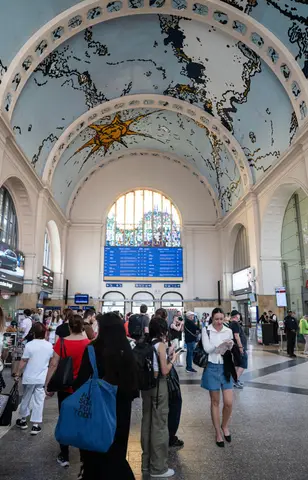
In 1859 the first railway station of the city started to operate; for military reasons timber was the basic construction material. Between 1907 and 1913 the German architects Rüdell, Jüsgen and Scheuffel planned and organized the gradual replacing of the half-timbering by modern building techniques. The monumental main building and the high clock tower are in “Moselle Baroque”. In the entrance hall a mosaic window discloses the outline of the city; the ceiling was repainted by the Luxembourg artist Armand Strainchamps.

  • Place de la Gare L-1616 Luxembourg

The former slaughterhouse now often functions as a venue for cultural events and exhibitions where local artists can present their works. It has also become a popular meeting place for skaters and street artists. This…

Read more

The former slaughterhouse now often functions as a venue for cultural events and exhibitions where local artists can present their works. It has also become a popular meeting place for skaters and street artists. This lively mix of historical architecture and urban art gives the Schluechthaus a unique identity that reflects the cultural diversity of Luxembourg in an exciting way.

  • 5 rue de l'Abattoir L-1111 Luxembourg

The auditorium at the Music Conservatory is a place not to be missed by music lovers, while the Museum of Instruments houses the piano on which Franz Liszt played for the last time in 1886.

  • 33 rue Charles Martel L-2134 Luxembourg City
  • Website
Data: Administration des transports publics and Luxembourg for Tourism, CC BY 4.0